
Uganda Gorilla Trekking vs Rwanda Gorilla Trekking
The question of Uganda versus Rwanda for gorilla trekking is not one with a universally right answer. It comes down to several practical variables: how much you want to spend on the permit, how much time you have for the trip, what kind of forest experience appeals to you, whether you are combining the trek with other safari activities, and whether the logistical simplicity of Rwanda or the wider-ranging character of a Uganda itinerary suits you better. This guide works through all of those variables honestly and directly so you can make the right call for your specific situation.

The Permit Cost Difference
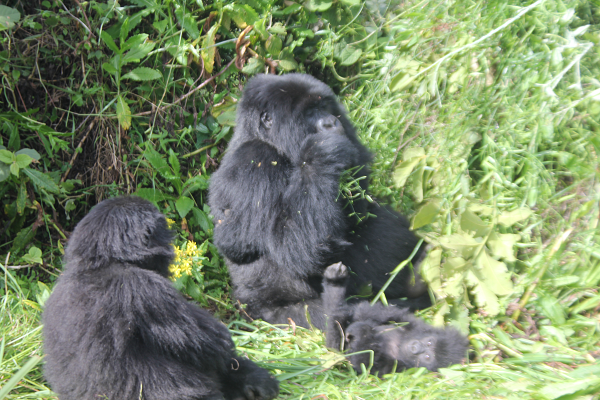
The permit price is where most people start, and it is the biggest single difference between the two countries. A gorilla trekking permit in Uganda costs USD 800 per person. In Rwanda, the same permit costs USD 1,500. Both permits allow you to spend one hour with a single habituated gorilla family, accompanied by a maximum of eight visitors and a ranger team. The biological encounter at the end of the trek is the same animal, the same species, the same one-hour rule, and statistically similar success rates in both countries. What you are paying USD 800 more for in Rwanda is not a different or better gorilla experience. It is a different country’s positioning, logistics, and broader tourism infrastructure.
Rwanda has deliberately set a high permit price as part of a conscious strategy to keep visitor volumes low and position the country as a premium destination. The revenue supports conservation, ranger salaries, and community program around Volcanoes National Park. Uganda’s lower permit price reflects a different approach: a wider range of habituated gorilla families, more trekking sectors across Bwindi Impenetrable National Park, and a broader accessibility across budget levels. The gorilla conservation funding mechanism works in both systems, and both countries have seen their gorilla populations grow as a result.
For budget-conscious travelers for whom the USD 800 difference represents a meaningful decision, Uganda is the clear choice. The gorilla encounter is the same, the quality of the experience is the same, and the savings can go toward more days in Uganda, additional activities, or simply a more comfortable trip overall. For travelers on a luxury itinerary where the total cost is already well above the permit price either way, the USD 800 gap matters less in percentage terms and the choice comes down to other factors.
Getting There — Uganda vs Rwanda
Rwanda — Short Drive, Simple Logistics
Rwanda’s main advantage from a logistics perspective is straightforward: Volcanoes National Park, where all gorilla trekking in Rwanda takes place, is two and a half hours by road from Kigali International Airport. Kigali has good international connections from most major European cities, the Gulf, and Nairobi. You can fly in, drive to the park the same day, stay one night near Musanze, trek the following morning, and be back in Kigali by early afternoon. A gorilla trek in Rwanda can theoretically be completed as a two-night extension to a regional business trip or to a larger East Africa safari itinerary based elsewhere. This logistical simplicity is genuine and it is worth something, particularly for visitors with limited time.
The Kinigi briefing point is the single departure point for all Rwanda gorilla treks, which means there is no confusion about which sector your permit applies to. Most lodges near Volcanoes National Park are within thirty minutes to an hour of the briefing point. The transfers are managed, the roads from Kigali are paved, and the overall experience from arrival to trek to departure runs smoothly. Rwanda has invested heavily in its tourism infrastructure, and it shows.
Uganda — Longer Journey, More Variety
Uganda’s main gorilla trekking destination, Bwindi Impenetrable National Park, is eight to ten hours by road from Entebbe or Kampala. That drive is a commitment, and it is one of the most cited reasons people choose Rwanda over Uganda. The alternative is a domestic flight from Entebbe to one of the regional airstrips near Bwindi, Kihihi, Kisoro, or Kabale, which reduces the journey to under two hours including the flight but adds to the cost. For visitors who have chosen Uganda primarily for the USD 800 permit saving, an extra USD 250 to USD 400 each way on a domestic flight partially narrows that gap.
However, the road journey from Kampala toward Bwindi also passes through some of Uganda’s most beautiful landscape. The drive through the Kigezi Highlands, past Lakes Bunyonyi and Mutanda, and into the hills surrounding the park is not purely a logistics obstacle. For visitors on a longer Uganda itinerary who are already including Queen Elizabeth National Park or Lake Bunyonyi, the positioning of Bwindi at the end of a circuit rather than as a standalone destination changes the calculation considerably. If you are combining gorilla trekking with other Uganda safari activities, the eight-hour drive becomes a manageable segment of a longer and more varied trip.
The Forests; Bwindi vs Volcanoes National Park
Both gorilla trekking destinations involve walking through tropical forest to find a habituated gorilla family. The forests are different in character, and the difference is noticeable.
Bwindi Impenetrable Forest, Uganda
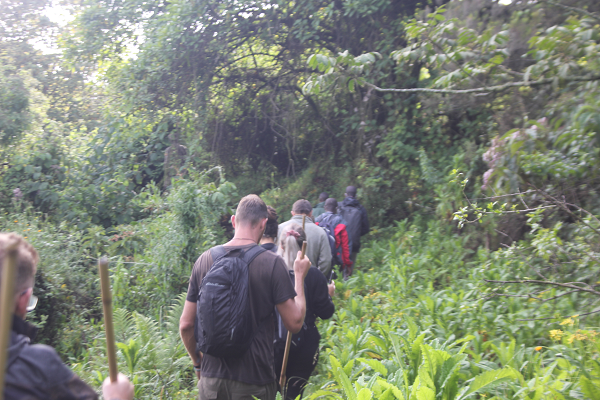
Bwindi is among the most ancient and biologically rich forests in Africa, covering 331 square kilometers of montane and lowland forest. The name is not exaggeration: the interior of Bwindi is dense, layered, and in places genuinely difficult to move through. Vines, roots, and understory vegetation create a trekking environment that requires physical effort and good footwear. Guides sometimes use machetes to cut a path through thicker sections. The altitude varies across the park’s four sectors, from around 1,160 meters at the lower Buhoma end to over 2,600 meters in the higher terrain. Trekking times vary considerably depending on where the gorilla family has ranged: from under an hour to a full day in the most demanding sectors.
For visitors who want a genuine forest adventure, Bwindi delivers it. The sense of being in a real, deep, ancient forest rather than a park that has been tidied up for visitors is part of what many trekkers describe as the most memorable aspect of the Uganda gorilla safari experience. The encounter at the end feels earned. The density and unpredictability of Bwindi is not a drawback for this group of travelers — it is the point.
Volcanoes National Park, Rwanda
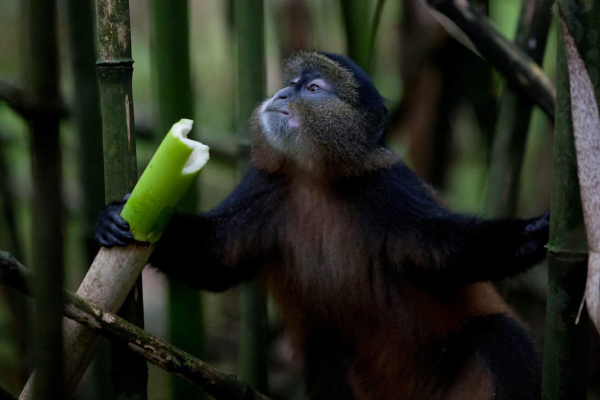
Volcanoes National Park covers 160 square kilometers of the Virunga Massif, a chain of eight volcanoes straddling Rwanda, Uganda, and the DRC. The trekking terrain here is different from Bwindi in a meaningful way: the lower elevations of the park, where most of the habituated gorilla family’s range, include significant sections of bamboo forest and more open volcanic slopes. The trails are steep in places but the vegetation is generally less dense than Bwindi, and the average trek distance to find the gorilla families is often shorter. Sabyinyo, one of the easiest gorilla families to reach, can be found within an hour to an hour and a half on many days. The larger families that range higher up the mountain, like the Susa group near Mount Karisimbi, involve longer and more strenuous hikes.
The views in Volcanoes National Park are also different from Bwindi. Where Bwindi offers a deep immersion in forest with no long sightlines, the Virunga slopes give occasional wide views across the volcanic landscape and, on clear days, toward the peaks of adjacent volcanoes. The park environment is more open and, in the assessment of many visitors, less intimidating physically than Bwindi. For older travelers, those with limited fitness, or visitors on short trips who want to minimize the physical risk of a very long or very steep trek, Rwanda’s Volcanoes National Park is a more predictable and manageable option.
The Gorilla Habituation Experience
One activity that Uganda offers and Rwanda does not is the Gorilla Habituation Experience, available in the Rushaga sector of Bwindi Impenetrable National Park. A standard gorilla trek in both countries gives you one hour with a habituated gorilla family. The Gorilla Habituation Experience gives you four hours, joining researchers and rangers as they spend the morning and early afternoon following a gorilla community that is still in the process of becoming accustomed to human presence.
This permit costs USD 1,500, the same as Rwanda’s standard gorilla permit. The difference is that four hours with a gorilla family, watching feeding cycles, social behavior, mother-infant interactions, and intra-family dynamics over an extended period, is a fundamentally different experience from a one-hour visit. The gorillas in the habituation program are less predictable and sometimes less settled than the fully habituated families, which adds a degree of rawness to the encounter. For serious wildlife observers, photographers, and anyone who wants the deepest possible connection to the animals, the Uganda Gorilla Habituation Experience is the strongest argument for choosing Uganda over Rwanda at equivalent permit cost.
Accommodation — Luxury and Budget Options
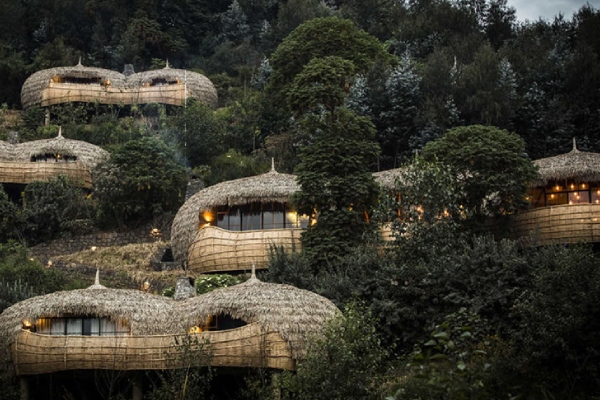
Rwanda has positioned itself as a luxury gorilla trekking destination, and the lodge infrastructure near Volcanoes National Park reflects that. Properties like Bisate Lodge, Singita Kwitonda Lodge, One &Only Gorilla’s Nest, and Sabyinyo Silverback Lodge are among the finest safari lodges in East Africa. Budget options near Musanze exist but are limited. Mid-range properties in the USD 200 to USD 400 per night bracket are available but narrower in selection than in Uganda. If your accommodation budget is comfortable, Rwanda is hard to beat for the quality of the lodges and the overall polish of the experience.
Uganda’s Bwindi accommodation covers a wider range. At the luxury end, Sanctuary Gorilla Forest Camp, Clouds Mountain Gorilla Lodge, and Mahogany Springs Lodge match Rwanda’s best properties. The mid-range, from around USD 200 to USD 400 per person per night, has more options and more variety across the four trekking sectors. Budget guesthouses in Buhoma and Rushaga give access to the trekking experience at a fraction of the cost of any Rwanda lodge. For visitors who need the accommodation budget to stretch as far as the permit savings allow, Uganda is the more flexible country.
Uganda vs Rwanda Gorilla Trekking — Side by Side
- Permit cost: Uganda USD 800, Rwanda USD 1,500. Both allow one hour with a habituated gorilla family.
- Gorilla families: Uganda has more habituated families across four Bwindi sectors plus Mgahinga. Rwanda has twelve families in Volcanoes National Park.
- Access: Rwanda is 2.5 hours from Kigali Airport. Uganda is 8–10 hours from Entebbe by road, or under 2 hours with a domestic flight.
- Terrain: Bwindi is denser, steeper, and more physically demanding. Volcanoes National Park has open bamboo forest and shorter average treks to most families.
- Gorilla Habituation Experience: Available only in Uganda’s Rushaga sector at USD 1,500. Not available in Rwanda.
- Additional activities: Uganda combines gorilla trekking with chimpanzee trekking, savannah safaris, the Nile, and mountain scenery across a longer circuit. Rwanda offers Akagera Big Five, Nyungwe chimps, and Lake Kivu in a more compact geography.
- Accommodation: Rwanda skews luxury with fewer mid-range and budget options. Uganda covers all budget levels across all four Bwindi sectors.
- Best for short trips: Rwanda. Two to three nights covers the full experience efficiently.
- Best for longer itineraries and budget travelers: Uganda. The permit saving, broader safari variety, and accommodation range suit ten or more days of travel.