
Gorilla Trekking Rules and Regulations
Gorilla Trekking Rules and Regulations: Mountain gorillas share an estimated 98% of their DNA with humans. That shared biology is what makes the encounter so touching, and it is also what makes the disease transmission risk between gorillas and humans genuinely serious. The global population of mountain gorillas was confirmed at just over 1,063 individuals in the most recent census. Every rule governing gorilla trekking in Uganda and Rwanda exists to protect that population from the risks that come with the activity that simultaneously funds their conservation. The two things are inseparable: responsible gorilla tourism pays for the rangers, the veterinary support, the anti-poaching work, and the community programs that have allowed the mountain gorilla population to increase from under 700 individuals in the early 2000s to over 1,000 today.
The rules below cover both Uganda and Rwanda, where the regulations are largely aligned. Where a specific rule differs between the two countries, that difference is noted. All visitors to habituated gorilla families in Bwindi Impenetrable National Park, Mgahinga Gorilla National Park in Uganda, and Volcanoes National Park in Rwanda are bound by these regulations without exception.

Age and Health Requirements
Minimum Age is 15 Years
The minimum age for gorilla trekking in Uganda, Rwanda, and the Democratic Republic of Congo is 15 years. This rule is applied without exception and is checked at the briefing point using the valid identification that all participants are required to present. Children under fifteen are not permitted to join the trek regardless of parental consent, physical capability, or the cost of the permit.
The age restriction exists for two connected reasons. First, children under fifteen are statistically more likely to carry viral infections such as chickenpox, mumps, and influenza, which can be devastating to gorillas whose immune systems have not been exposed to human disease strains. Second, the forest environment during a trek can require sudden stillness, quiet behavior, and a calm response to an unexpected animal approach. These responses are consistently difficult for young children to maintain. An alarmed or crying child near a habituated gorilla family is a serious disruption to the group and a risk to both the child and the animals.
Health Screening at the Briefing
Every visitor is screened for illness at the morning briefing before the trek begins. Rangers and guides watch for symptoms of respiratory illness: coughing, sneezing, runny nose, sore throat, and fever. Anyone showing these symptoms will be denied access to the trek. In Uganda, the UWA’s current policy provides a 50% permit refund if a park warden certifies that a visitor is genuinely too ill to trek, which is designed to encourage honest disclosure rather than concealment of symptoms. The logic is simple: it is better to lose half the permit fee than to risk transmitting a respiratory illness to a gorilla family.
If you feel unwell in the days before your trek date, notify your tour operator immediately. Do not attempt to conceal symptoms at the briefing. Gorillas share enough of our biology that a human cold or flu can cause severe illness in a gorilla, and the consequences for a small, isolated population can be far worse than the same virus in a human population. The illness rule is not a minor administrative formality. It is one of the most important conservation protections that gorilla trekking regulations include.
Rules During the Trek
The Morning Briefing
All participants must attend the briefing at the park headquarters before entering the forest. In Uganda, briefings at Bwindi’s sectors take place at 7:00 AM. In Rwanda, briefings at Volcanoes National Park’s Kinigi headquarters also take place at 7:00 AM. The briefing covers the assigned gorilla family and its current location based on the morning’s tracker report, the likely duration and terrain of the trek, the rules of behaviors near the gorillas, and answers to any questions from the group. The briefing ranger also assigns participants to families based on fitness levels disclosed by visitors: easy, moderate, and strenuous difficulty levels are offered at most trekking points. Disclosing your fitness honestly at this stage helps the rangers assign an appropriate family and pace.
Group Size — Maximum Eight Visitors Per Family
A maximum of eight visitors per habituated gorilla family per day is the global standard across all gorilla trekking destinations. This limit is enforced without exception. If your group at the briefing is larger than eight people, you will be divided and assigned to different families. The eight-person limit exists to minimize the cumulative disturbance of human presence on the gorilla family, to reduce the cumulative disease transmission risk, and to keep the encounter manageable for the ranger team accompanying the group.
Follow the Guide and Ranger at All Times
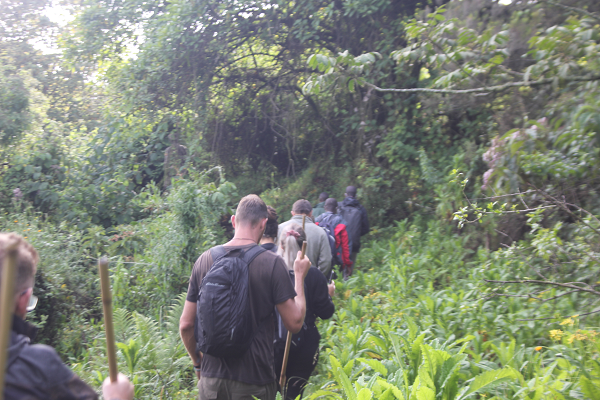
Your group is led through the forest by an experienced guide and accompanied by armed UWA or RDB rangers. Do not move ahead of the guide. Do not deviate from the route the guide is taking. In the forest, the guide is navigating toward the gorilla family based on information from the trackers who went ahead before dawn, and the route may not be obvious to an untrained eye. Following the guide also covers safety: the rangers accompanying the group are trained to manage unexpected wildlife encounters and know the specific behaviors of the gorilla family you are visiting. Their instructions are the ones to follow if something happens near the family.
Stay on Designated Trails
Walking off the designated trail is not permitted at any point during the trek. Leaving the trail damages the forest understorey, disrupts the habitat of other wildlife, and increases the risk of getting lost in dense forest where the vegetation makes orientation difficult. Park rangers clear the main trekking routes and know where the paths are stable and where the terrain is dangerous. Stay on the trail the guide has taken, even if you can see the gorillas at a different angle from a position off the path.
No Eating, Drinking, or Smoking During the Trek
Food, drinks, and smoking are not permitted from the point of entering the forest to the end of the trek. The rules exist because eating and drinking near gorillas introduces smells and potential contamination, and because smoking near wildlife is a clear disturbance. Water can be drunk at the guide’s designated break points away from the gorilla family.
No Flash Photography
Flash photography is strictly prohibited at all times during the gorilla trekking experience. The sudden bright light of a camera flash startles the gorillas and can trigger an alarm or defensive response in the group. Photograph using the ambient light of the forest and, if your camera allows it, the quietest shutter mode available. Many modern camera systems have a silent or electronic shutter that reduces the mechanical sound. In the dense forest, even lens autofocus noise can sometimes draw attention. Slow, quiet operation of your camera is the recommended approach.
No Drones
Unmanned aerial vehicles, including drones of any size, are strictly prohibited in and around gorilla trekking areas without a specific permit from the relevant wildlife authority. These permits are rarely granted. Do not bring a drone to the park or fly one in the surrounding area of the gorilla habitat. The noise, movement, and visual disturbance of a drone overhead is a serious threat to gorilla families, who may panic and scatter, disrupting the social structure of the group and potentially causing injury.
Rules During the One Hour with the Gorillas
The Eight to Ten Meter Distance Rule
The minimum distance between visitors and gorillas is eight meters in Rwanda and ten meters in Uganda according to the most recent tariff guidelines. This means approximately the length of two or three car lengths. The distance rule is one of the most important protections in gorilla trekking, because it creates a buffer that reduces both disease transmission risk and the likelihood of a physical interaction between a visitor and an animal. In practice, the distances during a gorilla encounter can be difficult to maintain with precision because the gorillas move, and a juvenile or younger family member may approach the group from the side. In these cases, the rangers manage the situation and instruct the group to step back calmly.
Do Not Make Direct Eye Contact with the Silverback
Extended direct eye contact with an adult male silverback gorilla can be interpreted as a challenge. If the silverback is looking at you, avert your gaze downward and avoid holding the stare even if the instinct is to keep watching. Your guide will demonstrate the appropriate posture and gaze direction before you approach the family. Respectful, non-confrontational body language around the silverback is important not just as a precaution but as a basic courtesy to the dominant animal in the family’s social hierarchy.
Do Not Run
If a gorilla charges, do not run. Running triggers a chase response in many primates and escalates a display into a physical pursuit. Most gorilla charges are bluff charges, displays of dominance that stop short of contact if the group stays calm, stays still, and follow the ranger’s instructions. Your ranger guide has seen this before. Crouching slightly, averting your gaze, and staying quiet are the appropriate responses. Follow the ranger exactly. Do not run.
Do Not Touch the Gorillas
Contact between visitors and gorillas is not permitted. Do not attempt to touch a gorilla regardless of how close it comes, how calm it appears, or how strongly the impulse to reach out feels. The reasons are both the disease transmission risk and the welfare of the gorilla: an animal that learns to accept touch from humans becomes habituated to a form of contact that rangers and veterinary teams cannot adequately control. The no-touch rule applies equally to juveniles and infants, which may appear approachable.
Do Not Eat Near the Gorillas
Any food or drink must be put away and out of sight before the group reaches the gorilla family. Food smells attract gorilla attention and can cause the animals to approach or become agitated. Eating during the encounter is not permitted. Wait until you are well clear of the gorilla family’s vicinity and back on the main trail before eating or drinking.
One Hour Time Limit — Strictly Enforced
The permitted time with the gorilla family is one hour from the moment of first contact, timed by the accompanying ranger. This limit exists to protect the gorillas from excessive human exposure. When the ranger signals the end of the hour, the group begins moving away from the family immediately. Some visitors find this the most difficult moment of the encounter: you have spent several hours walking to reach this family and a single hour passes faster than almost any other hour you will experience in your life. The hour ends regardless.
Environmental Rules in the Forest
No Littering
Everything you carry into the forest must come back out with you. Plastic wrappers, food packaging, water bottles, and any other waste must be returned to the trailhead. Do not bury waste in the forest. Do not leave anything behind at the gorilla family’s location or anywhere on the trail. Fines of up to USD 150 apply for littering in Uganda’s national parks.
Do Not Remove Anything from the Forest
Plants, insects, soil, rocks, feathers, and any other natural objects must not be removed from the forest. The gorilla habitat is a protected ecosystem and the removal of any element, however small it seems, is not permitted. This applies equally to curiosities collected at the trail’s edge during the walk in and out.
Human Waste
If you need to use the toilet during the trek, inform your guide. They will indicate an appropriate location and instruct you to dig a hole of at least 30 centimeters deep, use it, and cover it completely. This prevents contamination of the water sources and soil that the gorillas and other forest wildlife use directly. Do not urinate or defecate near any water source, trail, or gorilla habitat.